
The software engineer role is changing. So is the product manager role. And the gap between the two is narrowing faster than most companies have acknowledged.
This is not a theoretical trend. It is showing up in the briefs we receive from hiring teams across Bangkok and broader Southeast Asia every week.
Companies are asking for engineers with strong product instincts. They are asking for product leaders who can hold their own in deeply technical conversations. The overlap is real, it is growing, and it is reshaping what both roles actually require.
Why the Lines Are Blurring
The honest answer is AI.
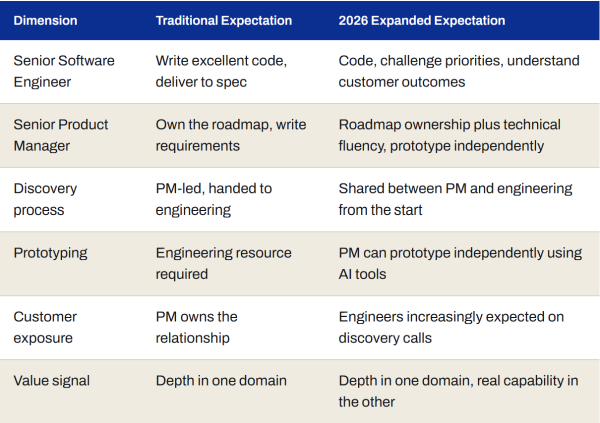
AI-powered development tools have compressed what used to take a team of three into something one skilled individual can do alone. A PM who can use tools like Cursor, v0, or Claude Code can go from a written spec to a working prototype in a single afternoon. That changes the power dynamic in the room considerably.
At the same time, engineers are being pulled closer to the customer. Discovery, prioritisation conversations, customer calls. The expectation that a senior engineer simply executes what lands in their queue is fading fast.
Product School put it plainly: in 2026, this overlap is not a bug. It is the operating model.
The structural numbers back that up. Andrew Ng noted at Y Combinator's AI Startup School that as engineering output accelerates through AI, teams are shifting from the traditional Silicon Valley rule of thumb of roughly 1 PM per 6 to 7 engineers toward a ratio closer to 2 PMs per 1 engineer. One of his own teams proposed exactly that. The model of large engineering organisations executing against product specs written elsewhere is already under pressure.
What Is Actually Changing for Engineers
The expectation is expanding well beyond the codebase.
Engineers are increasingly expected to understand the customer problem, challenge priorities with genuine context, and care about the outcome, not just the output. Technical depth still matters enormously. That has not changed. But pure execution, detached from product thinking, is becoming a thinner value proposition for senior hires.
In the US market, AI, ML and data science roles saw 163% year-over-year growth in job postings in 2025, with demand especially strong for engineers who can integrate AI-driven features (Robert Half, 2026 Technology Job Market report). The same directional pressure is visible across SEA. The bar is rising across the board, and the engineers rising with it are the ones bringing broader capability to the table.
In Thailand specifically, the skills gap makes this more acute. Thailand will need 1.08 million high-skilled professionals across its 10 targeted industries over the next five years, according to a survey of over 300 organisations conducted by NXPO and IRIS Consulting. When supply is tight, the engineers who can cover more ground become disproportionately valuable.
What Is Actually Changing for Product Managers
The pressure is coming from the other direction.
Product managers are expected to understand architecture, anticipate technical trade-offs, and increasingly, to build. Not necessarily to write production code. But to prototype, to validate ideas independently, and to operate credibly with highly technical teams without needing a translator.
The PM role itself is splitting into archetypes. One is the builder-PM: AI-native, comfortable shipping prototypes, working on teams that deliberately blur the PM and engineer boundary. The other is the integrator-PM: high-EQ, cross-functional, owning the roadmap in complex B2B environments where alignment is still a human problem.
Both archetypes require more technical fluency than the role demanded three years ago. The PM who cannot have a substantive conversation about architectural constraints or data model implications is finding their seat at the table getting smaller.
The market is recovering and competitive. By early 2026, tracking of LinkedIn listings put over 42,000 open PM roles globally (per product coach Ant Murphy's LinkedIn tracker), with Associate PM roles growing at 33% year-over-year. More roles, but also more scrutiny on what candidates actually bring.
This Does Not Mean the Roles Are Becoming the Same
This point matters, and it is worth being direct about it.
The strongest engineers we place are not half-PM. They are engineers with genuine technical depth who also understand customer outcomes and can engage meaningfully on prioritisation. The strongest product leaders are not half-engineer. They are product people with sound commercial and customer judgment who can hold a credible technical conversation.
The word being used increasingly in the market is *product engineer*. It is a useful shorthand, but it can obscure more than it reveals. Compensation is rising for people who can build hands-on and think about the full picture. It is not rising for generalists who do neither particularly well.
The scarce resource in 2026 is not execution. It is judgment, applied across a broader surface area than the traditional role description ever anticipated.
What This Looks Like in the Thailand and SEA Market
Thailand's tech sector is growing quickly. The software sector is projected to grow 9-10% between 2024 and 2026, with digital services expanding at 13-14%. The Thailand IT and security market is estimated at USD 8.95 billion in 2025, with one major analyst (Research and Markets) projecting it to reach USD 18.06 billion by 2030 at a 15% CAGR, though projections vary across research providers. Major cloud providers are investing heavily in the region.
That growth is generating demand faster than local supply can meet it. 40% of organisations in Thailand struggle to find the right talent, according to Michael Page's Talent Trends 2024 report, a figure that sits above the APAC average and points to a persistent structural gap. The government's goal of creating 280,000 new jobs in advanced sectors like AI, EVs, and semiconductors adds further pressure on an already thin pool.
In that environment, the people who combine genuine depth in one area with real capability in the other are not just preferred. They are often the only viable hire for the role a company actually needs.
In Southeast Asia more broadly, technical product managers and solutions architects already command a premium above standard PM and engineering rates, precisely because the hybrid skill set is rare and in demand.
A Comparison: Traditional Role vs. Expanded Expectation
What This Means for Employers
Be honest in the brief.
The companies that get this wrong are the ones that combine two job descriptions, label the output a hybrid role, and then reject every candidate because nobody scores 10 out of 10 on every line item. That is not a hybrid hire. That is two roles with one salary.
The right question is: what is genuinely essential for day one, what can be developed over six to twelve months, and what can the team around this person cover?
If you need an engineer with strong product instincts, define what that means in practice. Does it mean joining customer calls? Challenging the roadmap? Being able to write a sharp problem statement without PM support? Get specific.
If you need a PM who can operate with a highly technical team, define the floor. Does it mean reading a pull request? Understanding a data model? Being able to scope an API integration without three translation layers? Specificity here makes the search achievable.
Vague role design attracts vague candidates and produces long, frustrating searches.
What This Means for Candidates
The window to develop the adjacent capability is now, not when you next change jobs.
For engineers: product instinct is not a personality trait. It is a skill. Start with customer conversations if your current role allows it. Push back on tickets with context, not just technical questions. Read the company's metrics. Understand why the feature was prioritised, not just what it should do.
For product managers: technical fluency does not require a computer science degree. It requires curiosity and practice. Use AI tools to build something small. Get comfortable reading technical documentation. Learn enough about system architecture to ask better questions in sprint planning.
Neither side needs to become the other. But the strongest people in both roles will understand far more of the full picture than their predecessors did. That broader understanding is already showing up in hiring briefs across Thailand and Southeast Asia. It will only become more prominent.
Frequently asked questions
Are You Hiring for Depth, Breadth, or Both?
This shift is one of the more interesting hiring problems we work on at True Blue. The briefs are becoming more nuanced, the candidate pool is genuinely thinner at the overlap, and the gap between what companies say they want and what they actually need is wider than most hiring managers realise.
If you are trying to define a role at the product-engineering boundary, or looking for your next move as an engineer or PM who spans both worlds, we work across exactly this space in Thailand and Southeast Asia.
About True Blue
True Blue Recruitment Co., Ltd. is a Bangkok-based specialist IT recruitment firm focused on helping companies across Software, Cybersecurity, Data, Product, and Infrastructure hire the right talent to accelerate digital transformation.
Our tailored approach, deep market expertise, and strong local networks make us a trusted partner for some of Thailand's most innovative enterprises.